Home / Blog / Electronic Shelf Labels ROI in the Philippines
Electronic Shelf Labels ROI in the Philippines: Calculating True Labor & Paper Savings
Quick Executive Summary
What is the typical payback period for electronic shelf labels (ESL) in the Philippines? Most mid-to-large supermarkets and high-turnover convenience store chains recover their initial ESL hardware investment within 12 to 24 months through eliminated paper printing expenses, reduced store labor hours, and prevented register price discrepancies.
Where do the biggest cost savings come from? Labor reallocation accounts for over 60% of total ESL return on investment (ROI). Instead of paying store associates to spend 15 to 30 hours weekly printing, cutting, and swapping paper tags, branches execute synchronized price updates from head office in under 60 seconds.
When retail executives and purchasing directors evaluate electronic shelf labels in the Philippines, the first question is rarely about screen resolution or radio frequencies. It comes down to capital expenditure: how long does it take for digital price tags to pay for themselves?
On paper, traditional cardstock shelf labels appear cheap. A ream of paper and a roll of ink toner cost a fraction of an e-paper display. However, when you calculate the ongoing operational cost across an entire year—factoring in rising Metro Manila and provincial wage rates, supplier promo turnover, damaged cooler strips, and checkout pricing disputes—paper labeling becomes one of the most expensive manual workflows on the retail floor.
Understanding true electronic shelf labels ROI requires looking beyond hardware sticker prices and auditing the hidden operating expenses buried inside your monthly store profit-and-loss (P&L) statements.
The 3 Hidden Costs of Paper Price Tags in Philippine Stores
Most grocery and mini-mart operators underestimate how much manual tagging costs because those expenses are spread across payroll, office supplies, and register markdowns rather than sitting on a single line item.
1. Store Associate Labor Hours (The Largest Ongoing Drain)
In a standard 5,000-to-15,000-SKU grocery store or mid-sized supermarket, promotional cycles, supplier cost hikes, and seasonal discounts trigger anywhere from 500 to 3,000 price adjustments every week. Completing those updates manually involves a multi-step labor chain:
- Exporting price change batches from the back-office POS terminal.
- Formatting and printing paper sheets or adhesive stickers.
- Cutting strips manually with paper trimmers.
- Walking every aisle to locate the matching barcode and sliding each insert into shelf rails.
Even with experienced staff, manual relabeling averages 1.5 to 2 minutes per tag when factoring in printing, sorting, and walking time. At 1,000 weekly price changes, that equals roughly 25 to 30 labor hours every single week per branch. Across a 20-branch network, you are paying for hundreds of full-time payroll hours spent solely on paper maintenance rather than customer service or fast checkout.
2. Recurring Paper, Toner, and Plastic Rail Consumables
Unlike single-purchase digital hardware, paper labeling requires continuous monthly spending. Stores constantly reorder perforated card stock, thermal sticker rolls, color printer ink or laser toner, printer maintenance parts, and brittle plastic shelf-channel covers that snap or yellow inside humid aisles and refrigerated beverage doors.
3. Margin Loss from Delayed Promotions and DTI Fines
When a weekend promo ends at midnight Sunday, the POS terminal updates automatically on Monday morning. If your floor crew takes until Monday afternoon to finish replacing paper tags, customers still see the lower weekend price on the shelf. Under the Department of Trade and Industry (DTI) Price Tag Law, stores must honor the lower displayed price—eating directly into gross margins and risking administrative penalties. You can read our complete breakdown of these risks in our guide to DTI Price Tag Law compliance with electronic shelf labels.
Cost Comparison: Paper Workflow vs. Enterprise ESL
To illustrate how annual expenses compare for a typical high-turnover Philippine store carrying 5,000 active SKUs with weekly promotional updates, consider the operational breakdown below:
| Operational Expense Category | Traditional Paper Labeling (Per Branch / Year) | Automated Enterprise ESL (Per Branch / Year) |
|---|---|---|
| Relabeling Staff Labor | 780 to 1,500+ hours/year spent printing, cutting, and manually placing tags. | 0 hours. Updates push straight from head office or ERP triggers in under 60 seconds. |
| Paper, Ink & Printer Maintenance | Recurring annual expense on specialty card stock, color ink, adhesive stickers, and printer parts. | ₱0. Zero paper or ink consumption; e-paper retains images without backlight power. |
| Checkout Price Mismatches | 2% to 5% error rate causing register markdowns, customer friction, and DTI audit risks. | 0.00% discrepancy. Bi-directional RF handshakes confirm shelf tags match POS registers. |
| Chiller & Freezer Replacements | Frequent tag replacement due to condensation, curling paper, and torn adhesive labels. | None. Cold-rated e-paper housings operate reliably down to -25°C. |
Four Revenue Drivers Beyond Basic Cost Cutting
Calculating electronic shelf labels ROI strictly by subtracting paper and labor expenses only tells half the story. Modern digital shelving also generates measurable top-line revenue gains across Philippine retail formats:
1. Automated Day-Part & Perishable Markdowns
Fresh produce, bakery goods, and ready-to-eat meals lose value rapidly toward closing time. With paper labels, marking down expiring stock requires staff to print and stick manual discount tags—often too late to move inventory before spoilage. Automated ESL schedules trigger graduated price drops (for example, a 20% discount at 6:00 PM and 40% at 8:00 PM) automatically. Similarly, chains running electronic shelf labels for convenience stores and mini marts deploy automated breakfast bundle pricing during the morning rush and late-night snack deals with zero staff intervention.
2. Sponsored FMCG Endcap & Co-Op Advertising
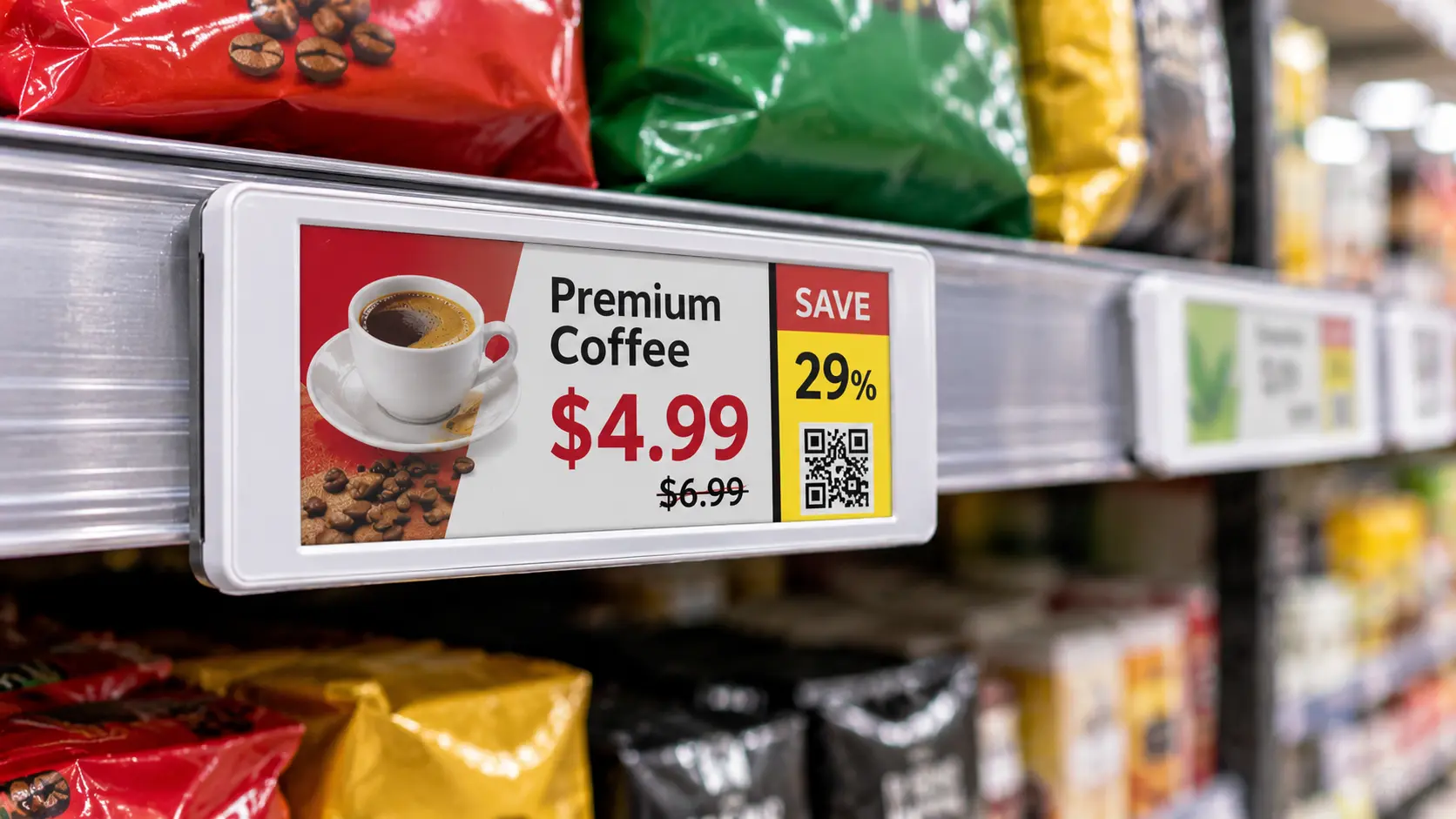
Major fast-moving consumer goods (FMCG) suppliers regularly pay for high-visibility promotional endcaps inside supermarkets and groceries. Using 4-color graphic displays like the Chroma Aeon Series, stores can display brand logos, red/yellow promo flags, and QR codes right on the shelf edge—allowing chains to command higher supplier co-op fees and launch sponsored campaigns nationwide on exact start dates.
3. Zero In-Store Server & IT Maintenance Costs
Older digital signage systems failed to scale across the Philippine archipelago because they required dedicated back-office computer servers in every single branch. Our enterprise wireless communicators eliminate that overhead completely. A single ceiling-mounted Power-over-Ethernet (PoE) gateway connects directly to the store’s broadband or 4G router, syncing thousands of labels to our central cloud platform with zero local IT footprint.

4. Protection Against Power Fluctuations
Because bi-stable e-paper displays only consume energy during the brief seconds a price changes, labels stay 100% legible even during unexpected store power outages or brownouts. Powered by user-replaceable cells rated for up to 10 years of operation, stores avoid the recurring maintenance cycles typical of backlit LCD screens.
The Simple Payback Formula for Your Stores:
Months to Breakeven = Total Hardware & Installation Cost ÷ (Monthly Labor Hours Saved + Monthly Paper/Toner Cost Eliminated + Monthly Margin Saved from Price Errors & Spoilage).
How to Estimate ESL ROI for Your Specific Store Network
Every retail operation has a different payback timeline based on branch format and pricing velocity. A high-frequency supermarket running 3,000 weekly promotions will hit breakeven faster than a slow-moving hardware store that changes prices twice a quarter.
To build an accurate financial projection for your management team, gather four baseline figures from one representative branch:
- Total Active SKUs: How many individual shelf-edge labels the store needs.
- Weekly Price Updates: Average number of items changed per week (including supplier promos and clearance markdowns).
- Store Staff Wage Rate: Daily or hourly labor rate (including benefits) for associates handling shelf tagging.
- Monthly Printing Spend: Total spend on paper stock, adhesive stickers, printer ink, and damaged rail strips.
You can plug these exact numbers directly into our interactive ESL ROI savings calculator to generate an instant yearly savings estimate and payback timeline in Philippine Pesos.
Next Steps: Validating ROI With a Single-Branch Pilot
Enterprise retailers rarely roll out new infrastructure across 50 branches on day one. The smartest path to proving your electronic shelf labels ROI is running a structured 30-day pilot in one flagship store or high-volume aisle.
During a pilot deployment, your operations team tracks actual labor hours saved, verifies ESL hardware durability inside coolers and high-traffic gondolas, and tests direct synchronization with your existing POS software. To learn more about how our Makati engineering team supports domestic retail rollouts, visit our About Us page.
Ready to Calculate Your Store's Payback Timeline?
Run your store numbers through our ROI calculator or visit our Makati City demonstration showroom to inspect physical tags and test POS integration.

Written by ESL Philippines Solutions Engineering
Specialists in wireless e-paper network architecture, retail POS integration, and automated store operations based in Poblacion, Makati City.